
OVERVIEW
Salesforce Education Cloud integrates AI to support students across the academic lifecycle. While AI tools offer efficiency and personalization, they also raise critical concerns around data privacy, transparency, and trust, especially in higher education environments where tool usage can feel mandatory.
This project explored how students perceive AI-powered education tools and how Salesforce might design AI experiences that help students feel informed, secure, and in control of their data.
PROBLEM
As AI becomes embedded in education platforms, students increasingly rely on these tools for studying, writing, coding, and planning coursework. However, many students lack clarity around:
What data is being collected
How long it is stored
Who has access to it
Whether they have meaningful choice or control
This lack of transparency places students in a passive position, where they feel obligated to accept AI systems without fully understanding their implications.
How might we ensure that university students feel informed, secure, and in control when AI-powered education tools collect and use their data?
RESEARCH APPROACH
We conducted qualitative interviews to capture perspectives across multiple roles within higher education, including:
A subject-matter expert
Faculty members
Undergraduate students
Graduate students
Alumni
Interviews focused on:
How students currently use AI tools
Awareness of AI data practices
Trust and mistrust in AI systems
Expectations around transparency and consent
All interviews were anonymized and synthesized collaboratively.
SYNTHESIS & ANALYSIS
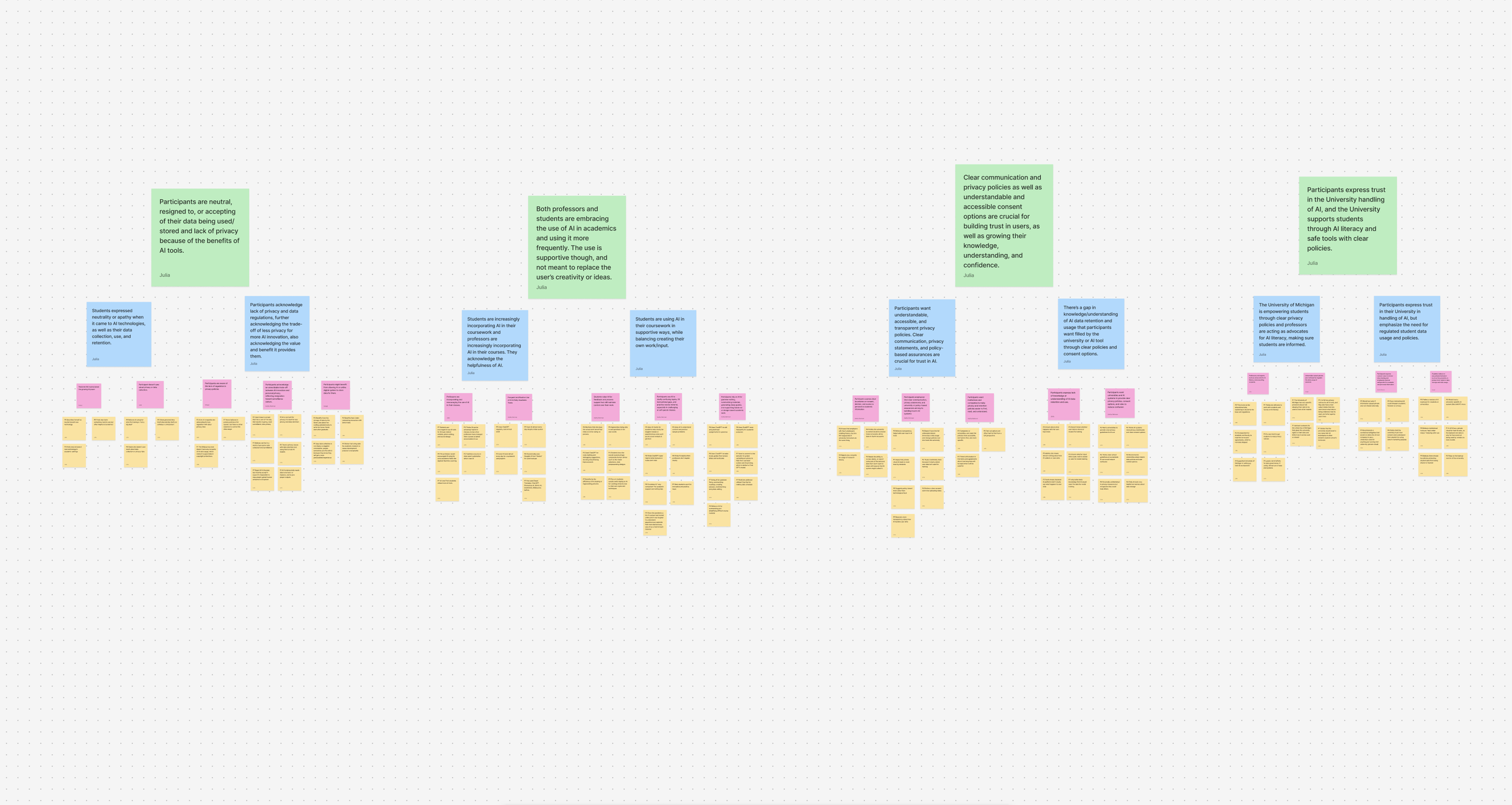
After interviews, our team translated qualitative data into themes using affinity mapping. We clustered observations related to emotions, behaviors, concerns, and needs to identify systemic patterns across participants.
KEY INSIGHTS
1. Privacy resignation is widespread
Students generally understand that AI tools collect data, but many feel they have no real choice.
Privacy policies are seen as unavoidable barriers rather than meaningful consent mechanisms. Students often click “agree” to complete required academic tasks, even when uncomfortable.
2. Students use AI as support
Students actively use AI to summarize readings, clarify difficult concept and proofread or refine work.
However, they consistently emphasized that creative ownership remains human-driven. AI is seen as a tool for reducing tedious work, not replacing student agency.
3. Mistrust stems from lack of transparency
Students expressed mistrust due to inaccurate or fabricated AI outputs, a lack of visibility into how AI decisions are made and fear of institutional surveillance
Even when institutional safeguards existed (e.g., data retention limits), students were often unaware of these protections.
RECCOMENDATIONS
1. Increase AI literacy through accessible education
Create student-facing learning materials (micro-lessons, onboarding modules) that explain:
What data AI tools collect
Why data is used
What “model training” means
Data retention and protections
Impact: Reduces anxiety, corrects misconceptions, and enables informed decision-making.
2. Provide meaningful student control and consent
Introduce a student-facing consent dashboard within Education Cloud that allows users to:
See what data is collected
Opt in/out of nonessential uses
Adjust consent over time
View logs of data access
Impact: Shifts students from passive acceptance to active participation.
3. Embed transparency directly into workflows
Surface real-time, plain-language explanations during AI interactions (e.g., tooltips, icons, short prompts) that explain:
What the AI is doing
What data it uses
Why it behaves a certain way
Impact: Reduces the “black box” effect and builds trust through clarity.
OUTCOME
Our research and recommendations were presented to Salesforce partners and aligned with their concerns around student trust and ethical AI adoption. The findings provided Salesforce with actionable, research-backed guidance for designing AI education tools that prioritize transparency, consent, and student agency.
REFLECTION
This project reframed my understanding of UX research beyond usability and interfaces, emphasizing ethics, power, and accountability in system design. Working with an enterprise partner reinforced the importance of translating abstract ethical concerns into concrete, feasible design guidance.
The experience strengthened my interest in ethical UX, data privacy, and trust-centered design, particularly within education and healthcare contexts.